SeeWandel-Klima
2025–2027
This is my current postdoctoral research at Eawag, the Swiss Federal Institute of Aquatic Science and Technology, within SeeWandel-Klima — Modelling the consequences of climate change and neobiota for Lake Constance (July 2023 – December 2027), the successor to the SeeWandel project (2018–2023). The programme brings together research groups around Lake Constance to deliver up-to-date projections of how climate change and invasive species will reshape the lake, and what that means for managing it.
Project description
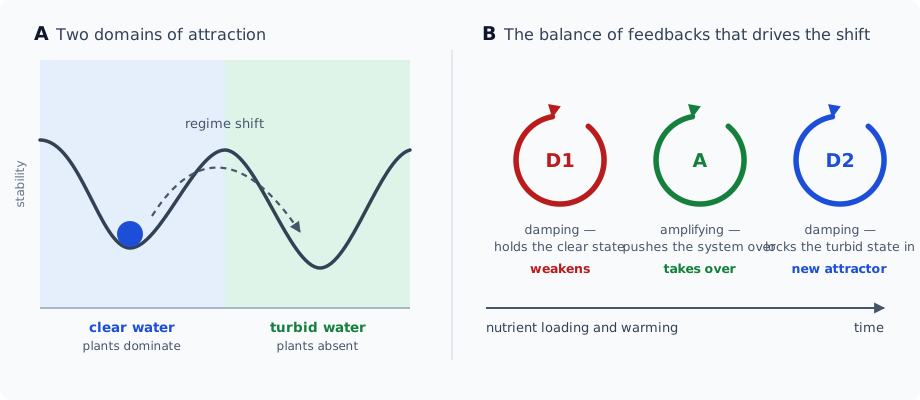
Climate warming and nutrient change are reorganising ecological networks and can drive regime shifts: abrupt, persistent, hard-to-reverse reorganisations of community structure. How a regime shift spreads through a community, and whether that pathway can predict it, is not established; early-warning indicators have proved unreliable.
Lake Constance is an unusually good place to ask this. It has been monitored monthly for four decades, across both the abiotic components of the system (temperature, nutrients, stratification) and the biotic ones (phytoplankton, zooplankton, fish), while passing through a large, well-documented nutrient trajectory — eutrophication and then re-oligotrophication — on top of steady warming. That gives us a long, closely observed record of a community that has demonstrably reorganised, rather than a system where we have to argue about whether anything happened at all.
Using these four decades of monthly records from peri-alpine lakes, we
- detect regime shifts in the abiotic and biotic components of the lake,
- reconstruct the pathway along which those shifts propagate from one component to another, and
- test whether we can predict the shifts that already happened — the honest test of any early-warning claim, since we know the answer in advance and cannot tune our way to it.
My role
I am the postdoctoral researcher carrying out the analysis: assembling and harmonising the long-term monitoring series, detecting the shifts in each component, and building the models that reconstruct and test their propagation. The work is developed in the open from the start — the code lives in see_plankton_change, and the methods I develop along the way, such as the Gaussian-Process / Empirical Dynamic Modelling toolkit NLA, are released separately.
Project leader
Francesco Pomati 
- Project leader · group leader, Department of Aquatic Ecology
- 🏦 Eawag, Switzerland · lecturer, Institute of Integrative Biology, ETH Zürich
- 🔗 Profile
Collaborators
Luis J. Gilarranz
- Regime shift detection and propagation in ecological networks
- 🏦 Department of Aquatic Ecology, Eawag, Switzerland
- 🔗 Google Scholar
Stephan B. Munch
- Nonlinear population dynamics, ecosystem forecasting, Gaussian-Process methods
- 🏦 NOAA Fisheries and University of California, Santa Cruz, USA
- 🔗 Google Scholar
Tanya L. Rogers
- Community ecology and empirical dynamic modelling of population time series
- 🏦 NOAA Fisheries and University of California, Santa Cruz, USA
- 🔗 Google Scholar
Marta Reyes 
- Food-web interactions and plankton responses to environmental change
- 🏦 Research technician, Department of Aquatic Ecology, Eawag, Switzerland
- 🔗 Profile
Stefanie Eyring 
- Research assistant, Plankton Ecology group
- 🏦 Department of Aquatic Ecology, Eawag, Switzerland
- 🔗 Profile